
What is Plutus
A private, automated trading system: a daemon that wakes at 06:45 ET, pulls data, computes one frozen picture of the world, lets each strategy decide, and trades paper accounts — while a backtester replays the same code against thirty-three years of history.
The one-sentence version
Plutus takes the instruments Grade My Investments already publishes — regime, grades, macro readings — adds market-priced signals, news, and Claude research, and turns them into trading decisions with a full reason chain. It runs alongside GMI; it does not replace it, and nothing Plutus does is ever marketed as GMI output.
The system is built on Azure, .NET 10, Blazor, MySQL and blob storage, in the same lean-cloud posture as GMI: a small VM, a small database, and the bulk of the data in cheap blob — about $90–100 a month when the estate is fully up, and about a quarter a month today.
What makes it different
It distrusts itself on purpose
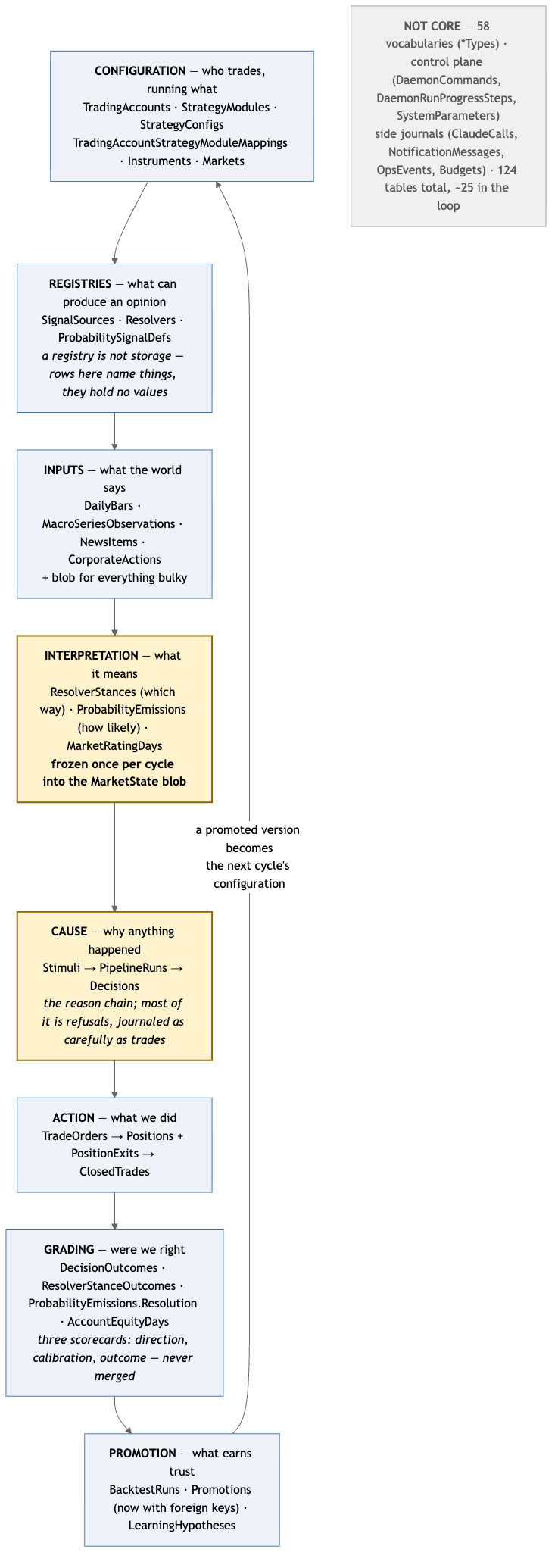
Most stimuli die in the entry gauntlet, and the row records which stage killed them. A strategy, a resolver, or a probability signal climbs a ladder — Draft, Shadow, Active — and nothing reaches Active without a track record.
Backtests are the same code
decide(MarketState) → TargetWeights is synchronous and pure. The backtester feeds it history; the daemon feeds it today. Neither host can be told apart from inside the strategy.
Allocation is an experiment, not an argument
Paper accounts are free, so the question "is 60/40 better than regime-adaptive?" is three accounts and a leaderboard, not a meeting.
The world is point-in-time
Macro data arrives on its release date, not its reference date. The regime is acted on when it was knowable, not when it became true. The calendar is measured from real trading days, not assumed.
The posture split with GMI
Decided on 2026-08-24, and it governs everything: the GMI Tracked Portfolio is GMI's published product, transparent and rules-based. Plutus is private capital, results off the GMI site, free to use signal families the published product never would. The two share plumbing — the data layer, the Azure patterns, the design standards — and nothing else.
Plutus reads from GMI through a deliberately narrow door: three coarse endpoints and a nightly export, no database access at all. How that boundary works.
- Stock lane — S&P single names, the Mag 7 core
- ETF lane — the eleven SPDR sectors and SPY
- Cash proxy — BIL only, never a rate view
- No bonds, no options, no day trading in v1. Hourly decisions; the morning cycle plans.
- Trade into an earnings print
- Let a human view flip a stance on its own (25-point cap)
- Publish a number as a probability from anything but the probability engine
- Count a hypothesis's own origin window as evidence
- Place a live order before three gates and a person