
A trading system that journals its refusals.
Plutus is a private, automated trading engine built on Azure and .NET. It computes the world once, freezes it, lets the same compiled code decide in three hosts, and grades every opinion it has ever held. This site is how it is engineered — with the real numbers, including the ones that failed first.
The −0.73 % is the honest residual: FMP reinvests dividends on the ex-date, Plutus credits them on the pay date. The first attempt failing is on the ledger because that is what a ledger is for. How the gate works.
Three ideas hold it together
Every row points back to its cause
A closed trade points to its order, the order to its decision, the decision to the gauntlet it passed, the gauntlet to the line that crossed, and that to the frozen world. Foreign keys, not log correlation.
The reason chainThe world is computed once, then frozen
Strategies never fetch. They receive a MarketState and return weights — synchronous, pure. The identical bytes run in the backtester, the paper daemon, and live, so a backtest is evidence about live behavior, not about a lookalike.
Every opinion has its own scorecard
A resolver says which way; a probability says how likely; a decision says what to do. Three claims, three outcome tables, three ways of being wrong. Nothing is trusted without a track record.
Resolvers & probabilitiesAbout Plutus
What is Plutus
A private system that runs alongside Grade My Investments, uses GMI's instruments and data, and trades paper accounts in a tournament — with nothing marketed as GMI output.
What it isThe build log
Twenty-nine design documents came before the first line of engine code. Then a news archiver, a decided Phase 0, a validated schema, and a backtester — each behind a gate, each recorded with what it got wrong first.
Read the logWhat is this site
The Engine Room is the sister of GMI's Technology Observatory: the same discipline of publishing how a thing is built, for a system that is private by design.
About this siteMeet the solutions architect
Allan Edwards designed GMI and Plutus. On Plutus he directs construction and reads the code as it lands — the design calls are his; the keyboard, mostly, is not.
Meet Allan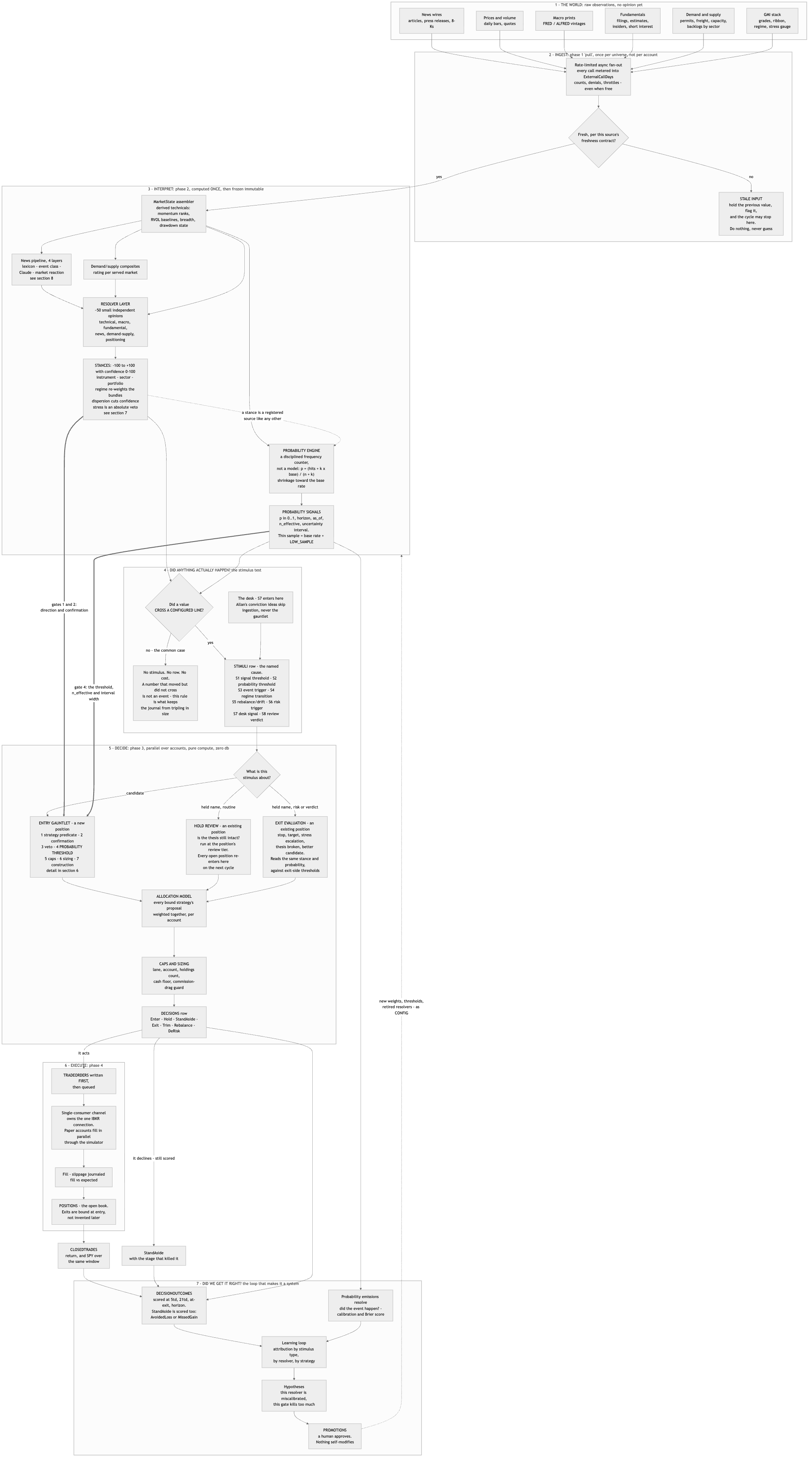
schema, calendar, cadence, backtest rowsdecided
364 days, 627,754 items, zero gapsgate passed
waits on three endpoints and an exportgated
spy-hold 1993→2026 within tolerancegate passed
the C# side of 124 tablesnext
paper only; the cloud momentlater
| Design documents before code | 29 |
| Tables in the schema | 124 |
| JSON columns, before → after review | 39 → 10 |
| News items archived | 627,754 |
| Trading days replayed | 8,455 |
| Special closures named in the calendar | 11 |
| Contract tests | 12 / 12 |
| Live capital | 0 |
Paper only. Nothing places a live order, and nothing will until it has passed a backtest gate, a paper-track gate, and a human. The system's main product is refusals, journaled as carefully as trades.
Nothing here is investment advice. Plutus is a private engineering project.